Financing a Self-Storage Facility
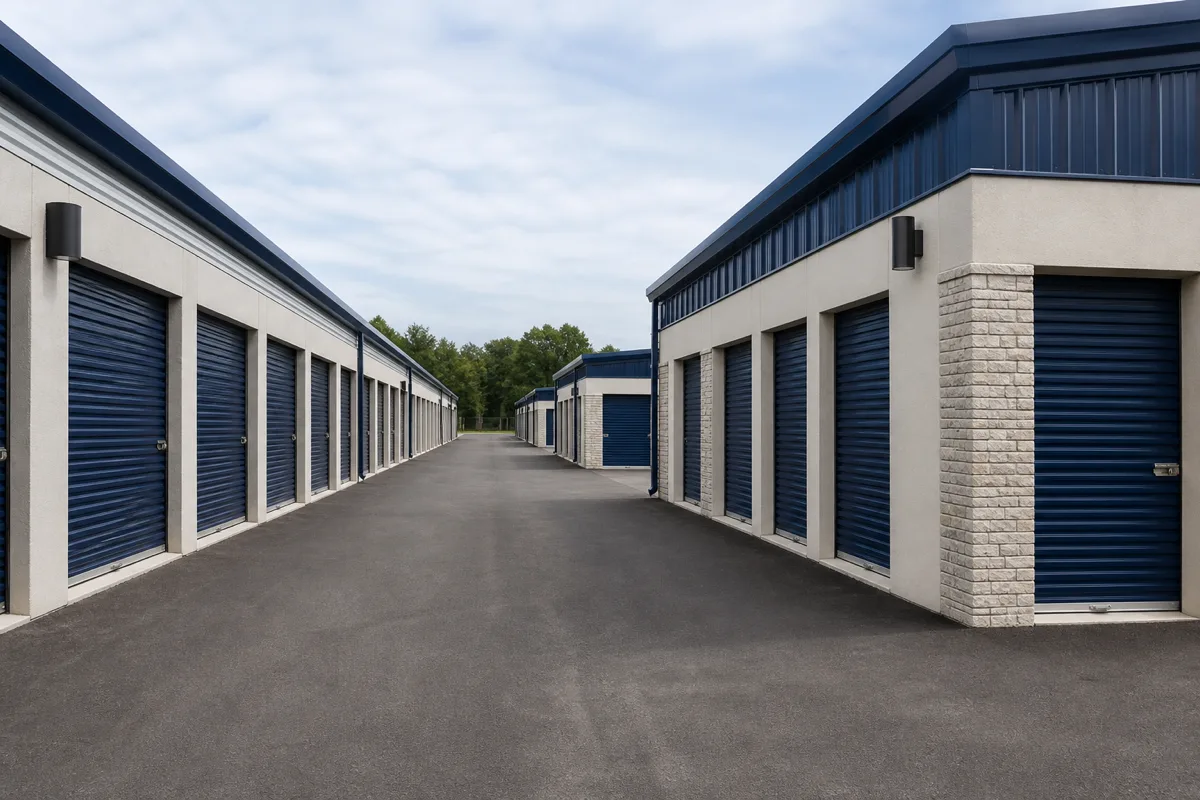
Financing a self-storage facility as an investment property runs closer to standard commercial real estate underwriting than residential rental financing — capital sources evaluate the asset primarily on its historical occupancy, in-place rent roll, and expense ratio, rather than a single-tenant lease.
Self-storage has become a favored asset class for commercial investors because of its comparatively low operating overhead and resilience across economic cycles. But financing one requires understanding a few metrics that don’t come up in single-family or small multifamily deals.
Key Metrics Lenders Evaluate
Physical vs. Economic Occupancy
Physical occupancy measures how many units are rented out of total units available. Economic occupancy measures actual rent collected against total potential rent at full market rates. A facility can show 90% physical occupancy but a much lower economic occupancy if legacy tenants are paying well below current market rates — capital sources typically weight economic occupancy more heavily when sizing a loan.
Net Operating Income (NOI)
Self-storage typically runs lean on operating expenses relative to gross revenue — no tenant improvements, minimal common-area utilities, and low staffing needs compared to office or retail. That expense efficiency is part of why it underwrites favorably, but it also means the NOI calculation deserves careful scrutiny: verify what’s actually included (management fee, reserves for capital expenditures, property tax, insurance) versus what a seller’s pro forma might be omitting.
Unit Mix and Climate Control
Facilities with a mix of standard drive-up units and climate-controlled interior units often command higher rents per square foot on the climate-controlled portion. Lenders and appraisers look at the unit mix relative to local demand — an oversupply of large vehicle/RV storage in a market that mostly wants small climate-controlled units can weigh on the valuation.
Loan Structure Basics
Self-storage financing commonly follows standard commercial loan structure:
- Loan-to-value: Typically in the range most stabilized commercial assets see, with lower leverage for value-add or lease-up properties compared to fully stabilized facilities
- Debt service coverage ratio (DSCR) as an underwriting metric: Even though this isn’t a residential DSCR rental loan, the same debt-service-coverage math (NOI ÷ annual debt service) is central to how commercial lenders size self-storage loans
- Amortization and term: Commercial amortization schedules (often 25 years) with a shorter loan term and a balloon or refinance point are common, similar to other commercial property types
Stabilized vs. Value-Add Self-Storage
- Stabilized facilities with 2+ years of consistent occupancy history and documented rent rolls typically qualify for the most straightforward commercial financing terms.
- Value-add or lease-up facilities — recently built, recently converted, or under-managed properties with room to raise rents and occupancy — often require a more conservative initial loan amount, sometimes paired with a plan to refinance once the property stabilizes at target occupancy.
Reserves and Cash Flow Cushion
Given seasonal booking swings in some markets (moving season spikes, college-town cycles), many capital sources ask for reserves covering several months of debt service, taxes, and insurance, especially on facilities without a long stabilized operating history.
Market Supply Analysis Before Buying
Self-storage markets can oversaturate quickly relative to other commercial asset classes, since facilities are comparatively fast and inexpensive to build compared to office or multifamily. Before financing a purchase, experienced investors typically research:
- Square feet of storage per capita in the trade area, compared against national or regional benchmarks
- New supply in the pipeline — permits filed or facilities under construction within the competitive radius
- Rate trends at competing facilities — whether nearby operators are raising or discounting street rates, which signals demand strength or weakness
A facility that looks strong on trailing financials can still face real rent pressure if a new competitor is opening down the road — lenders and appraisers factor local supply trends into their underwriting, and investors should too.
Third-Party Management vs. Self-Management
Self-storage differs from most commercial property types in how lean the operations can run — many facilities operate with minimal on-site staff, using automated gate access, remote video monitoring, and centralized call centers instead of a full-time on-site manager. Investors choosing between self-management and a third-party self-storage management company should factor the management fee (typically a percentage of gross revenue) into the NOI projection used for loan sizing, since it materially affects the debt-service-coverage math either way.
Frequently Asked Questions
Do I need prior self-storage management experience to get financing?
Not always, but many capital sources view direct property management experience — self-storage or other commercial real estate — favorably, since it reduces perceived operational risk. First-time self-storage investors with strong general commercial property experience are often still considered.
How is a self-storage facility appraised differently than an apartment building?
Appraisers typically use an income approach based on economic occupancy and expense ratios specific to self-storage, along with a sales-comparison approach using recent self-storage transactions in the market — rather than a per-unit residential comp approach.
Can I finance a facility that includes both storage units and outdoor vehicle/RV parking?
Yes, mixed-use storage facilities (interior units plus outdoor parking) are commonly financed together as a single commercial asset, with the overall NOI reflecting both revenue streams.
What down payment is typical for a self-storage facility purchase?
Down payment requirements vary by loan-to-value guidelines and property stabilization, generally following standard commercial property ranges rather than a fixed percentage specific to self-storage.
Are new-construction self-storage projects eligible for this type of financing?
Ground-up construction and development-stage projects fall outside standard investment-property financing on this site — this content covers financing an existing, income-producing self-storage facility as an investment purchase or refinance.
For industry occupancy and rate trend data, see the U.S. Census Bureau’s Quarterly Survey of Property Owners and Managers, which tracks broader commercial property performance context.
Have a commercial or mixed-use investment property in mind? Start with a confidential inquiry or call (907) 841-1600.
Related reading: Small Multifamily Commercial Loan Basics, Commercial Property Loan Requirements Checklist, Warehouse Investment Property Financing
Have a property in mind?
Submit a confidential inquiry — business-purpose and investment property only.
Start InquiryDisclaimer: This article is for informational purposes only and does not constitute financial, lending, legal, or tax advice. Commercial & DSCR Loans is a marketing and referral information service — not a lender, broker, or financial institution. Content relates to business-purpose and investment property financing only. Disclaimer · Terms · Privacy